
While LINC and Refugee Claimant students have many characteristics and needs in common, there are key differences in their immigration statuses that need to be recognized and accounted for by the teacher during lesson planning and delivery.
LINC Students
LINC students are permanent residents, convention refugees, or protected persons who are eligible for federally funded language training. These learners are on a more stable immigration pathway, allowing them to focus on long-term language development. LINC students are eligible for a variety of government funded programs based on need.
Refugee Claimant Students
Refugee claimant (RC) students in the BC Safe Haven program are individuals seeking asylum in Canada whose immigration statuses are still in process. They often face immediate challenges related to employment and income, housing, healthcare, and legal processes, making their language needs more urgent and survival-based. Unlike LINC students who know they can stay in Canada permanently, RC students’ futures are full of uncertainty because they will have to return to their homeland if their refugee protection application is refused. Yet, RC students are resourceful and working hard to support themselves.
One Class, Two Realities
Refugee claimants in LINC classes experience the same class structure and content as other LINC students, but within the context of vastly different life circumstances. Their teachers are generally more familiar with the learning needs and styles of the regular LINC students who make up the majority of the class’s composition. Class delivery may be tailored solely to the LINC students, at the expense of the smaller number of refugee claimants. This is especially problematic when choosing assessment tasks: many LINC curriculum themes may carry implicit assumptions about students’ life circumstances — a reading assessment on Housing, for example, might ask a student to read a strata board notice, while a writing assessment on Family could trigger traumatic memories and experiences that refugee claimants are already struggling with.
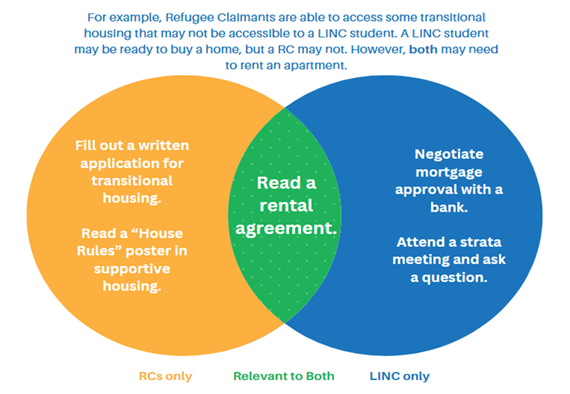
LINC teachers therefore need to be careful when choosing lesson themes and tasks, both to ensure these lessons address the learning needs of both LINC and Safe Haven clients, and to provide a safe, supportive and inclusive learning environment for RCs.
With these difficulties in mind, here are some additional strategies aligned to the Safe Haven Language Curriculum principles.
1. Understand and accommodate attendance, motivation, and focus challenges.
- Be flexible and supportive: recognize that attendance may fluctuate, and students may struggle with staying engaged. Offer understanding and flexibility and provide support to help them stay on track despite these challenges.
- Acknowledge the challenges. RC students may face financial difficulties and uncertainty about their immigration status in Canada. Financial struggles may require them to work extra hours or leave class early, resulting in inconsistent attendance. Additionally, the uncertainty surrounding their status can negatively affect their motivation and focus on class.
2. Tailor content to refugee claimants’ needs.
- Prioritize key topics: make sure to include topics that are specifically relevant to refugee claimants, which may not apply to other newcomers, during needs assessments when introducing a new theme or topic. For example, in a unit on Housing, include information about temporary housing or shelters. Present these alongside other types of housing to avoid singling out RC students, ensuring they don’t feel that their situation is being highlighted. Similarly, in Food and Nutrition, consider including food banks; in Health, incorporate topics like the Interim Federal Health Program (IFHP) to address the unique needs of RC students.
- Avoid sensitive subjects: be cautious when addressing sensitive topics such as family separation or trauma, as these could trigger emotional responses or distress in students.
3. Apply Trauma-Informed teaching practices.
- Understand trauma: many RC students have experienced trauma. Approach teaching with patience, flexibility, and empathy.
- Create a safe space: ensure your classroom feels physically and emotionally safe. Consider factors like room layout, noise levels, and structure to minimize any stressors.
- Watch for triggers: be mindful of possible environmental triggers that may overwhelm students. Adapt your lessons to be calming and predictable.
4. Foster community and connection.
- Build a supportive classroom culture: incorporate community-building activities daily into your lessons to address issues of loneliness or family separation.
- Help students feel that they belong: make sure each RC student feels valued and part of the classroom community. Group activities, peer interactions, and shared goals can create a sense of unity.
5. Use Universal Design for Learning (UDL).
- Use a three-station model: organize your lessons with a rotation of collaborative, digital, and teacher-led stations at least once a week to address various learning needs.
- Provide extra support: Ensure that teacher-led stations provide additional guidance to RC students who may need more support. This approach allows you to address their individual challenges while maintaining equity, ensuring that RC students don’t feel singled out and that other students feel equally supported.
6. Be flexible with accommodations for assessments.
- Offer flexibility: provide extended time for assessments or adjust pacing when necessary.
- Focus on formative assessments: use ongoing assessments (like quizzes, group work, and class discussions) to give feedback and encourage progress. Avoid relying solely on high-stakes tests.
7. Ensure accessibility and inclusivity.
- Adapt materials: ensure that all classroom resources, including handouts, digital tools, and visual aids, are accessible to students with varying abilities.
- Promote inclusivity: create an environment that respects and values the diverse backgrounds and experiences of RC students. Use culturally relevant materials and be aware of the different challenges students may face.
Guidance for LINC Themes
Below is a list of themes used in LINC classes, based on the National LINC Curriculum Guidelines. Each theme includes sample real-world tasks that are particularly relevant to refugee claimants, as well as counterparts that would not address RC’s current situations. Making informed decisions about lesson topics and tasks in a LINC class can ensure refugee claimants are included and their needs for trauma-informed material addressed without singling out their situations to their peers.
| LINC Themes | Sample tasks that are inclusive and trauma-informed for RCs | Sample tasks that are not inclusive or trauma-informed for RCs |
|---|---|---|
| Banking and Numeracy | · Listen to a friend’s advice about low-fee bank accounts. | · Listen to a friend’s advice about how to increase your credit score. |
| · Ask a bank teller for your banking information to set up a direct deposit for employment. | · Talk to a bank representative about retirement plan options. | |
| · Read a credit card statement to compare your income with your spending. | · Read and compare the mortgage financing options from two banks. | |
| Canada | · Ask your coworker about statutory holidays in BC, and check or copy the dates into your phone calendar. | · Plan a sight-seeing recreational trip across Canada. |
| · Listen to your neighbour describing Canada Day celebrations. | · Read a “Discover Canada” chapter to prepare for the citizenship test. | |
| Community and Recreation | · Search online for services in your area and write down contact information. | · Call a travel agent to book a vacation. |
| · Listen to a news report about an upcoming community celebration. | · Make a phone call to a charity to inquire about how to make a donation. | |
| Equity, Diversity, and Inclusion | · Fill out an application form to volunteer at a Pride parade in your area. | · Describe a family reunion event to your friend. |
| · Describe your cultural background to your coworkers and ask them about theirs. | · Engage in a discussion about human rights in one’s first country. | |
| · Report an incident of discrimination and ask for help. | ||
| Education and Learning | · Listen to instructions on how to use search engines to look for a job. | · Listen to instructions on applying for training in a trade. |
| · Talk to your child’s schoolteacher at a parent-teacher meeting. | · Talk about extracurricular activities your child is enrolled in. | |
| Employment: At the Workplace | · Write an email to your supervisor to update your availability. | · Listen to your supervisor’s instructions on joining the company’s retirement plan. |
| · Phone a coworker to ask if they can switch shifts with you. | · Have a conversation with your coworkers about the best restaurants in town. | |
| Employment: Finding a Job | · Read a job posting online and decide if the job description matches your skills and qualifications. | · Explain a gap in your employment history during a job interview. |
| · Ask your neighbor if the company they are working for is hiring. | · Answer the question, “Where do you see yourself in five years?” during a job interview. | |
| Getting Around and Transportation | · Look up the bus schedule for a route and plan your trip accordingly. | · Ask a travel agent about popular tourist destinations. |
| · Listen for announcements on the train to ensure you are getting off at the right stop. | · Listen to a salesperson explaining long term financing for buying a new vehicle. | |
| Global Citizenship | · Listen to your landlord’s instructions on how to sort your household waste. | · Talk to your neighbor about the city’s proposal to build a homeless shelter in your neighborhood. |
| · Read a post about how to reduce your household water and energy consumption. | · Call the city to get information about recycling old furniture. | |
| Health and Wellness | · Read an article about breathing exercises for stress relief. | · Read instructions on how to apply for MSP. |
| · Listen to a pharmacist explain the information on the medicine label. | · Follow instructions on how to maintain a healthy work-life balance. | |
| Home and Neighborhood | · Call a property manager to report a problem in your rental unit. | · Ask your bank advisor about mortgage options for purchasing a house. |
| · Give step-by-step directions from the closest bus stop to get to your apartment. | · Read online about the minimum income requirements for applying for long-term subsidized BC housing. | |
| Indigenization | · Write a land acknowledgment to share at meetings or events. | · Listen to an Indigenous person speak about the mistreatment of children in residential schools. |
| · Listen to a podcast about the role of sharing circles in healing. | · Watch a news story about the unmarked graves of Indigenous children in BC. | |
| Shopping | · Look up customer reviews of a product before making an online purchase. | · Compare the features of different brands of home entertainment systems and decide which one to buy. |
| · Ask a store employee about an item that you can’t find on the shelves. | · Listen to a representative explain the store’s five-year financing payment plan. | |
| · Listen to a cashier explain the store’s return policy. | ||
| Social Connections and Relationships | · Introduce yourself at a social gathering. | · Offer your condolences to a coworker who has lost a family member. |
| · Listen to a friend talk about a family member who identifies as a member of a 2SLGBTQIA+ group | · Chat with a friend about your family back home. |